Showing posts with label Physical activity. Show all posts

13 March, 2014

Thumping Thursday: Using body percussion to get students moving and musical

While your students may not be
'Stomp,' they may already be familiar
with body percussion.
As a musician, I love introducing music in the classroom. Lately I have re-discovered the beauty of body percussion. Need to re-discover it yourself? Here's the YouTube playlist I have compiled to inspire me. While our students may not be quite musically inclined or have the talent enabling them to perform a Stomp number in assembly, it's easy to see how much some students enjoy body percussion. See those girls doing hand claps during recess? That's body percussion right there! Add in a few masculine yells to a war dance and even the boys will get on board. In fact, when I introduced a combination of body percussion and yelling into a kinder room they didn't stop until they were sore!

So here's a small group activity to get them noisy, musical, active and engaged. I hope your rooms are somewhat sound proof or you may want to take it to the auditorium or outside.

Begin by standing the group in a circle. Explore as a group what sounds you can make using your body (and if you want, you can add voice and just ban 'singing real words' and see what they come out with). As the students explore different sounds, suggest they try making one sound different by changing speed, force, direction, etc. They can even change the way their hands sound by making them flat or cupped. Once you feel you have a variety of noises, start to describe and categorise them, especially by loud and quiet. For example, quite noises could be brushing their arms, rubbing their hands together, or scooting across the floor/ground. Bringing them back to the circle (as they may have moved around a bit by now) ask three people to start with a quiet action, repeating it in a pattern. After a few repeats, add another small group with another noise pattern. Remember, you may ask some to make noises, even if they are just saying, "do... do do... do do." This will add another layer to the music. Continue this until everyone is making a pattern. Congratulate them on creating a song together!

After completing this as a group, you may split the class into small groups to create their own body percussion songs.

As an extra exploration activity, you can play a variation on a well-known detective game. Send someone out of the room and nominate a student as the 'conductor.' They begin an action (body percussion) and the rest of the class follows like an orchestra. After this is going, invite the detective in to discover the conductor. In order to avoid detection when changing the sound, the conductor will usually only get away with a quieter sound or the detective will know what area they are in. Due to this, the best strategy is to start loud and get quieter and quieter until the actions are almost silent.
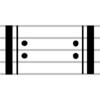
Repeat symbols
An an extension activity, you can begin introducing basic notation. Invent symbols as a class to represent symbols such as a clap, silence (rest), stomp, etc. Begin with simple beats and then begin to change speeds, etc. Problem solve as a class how you can show the same instrument at played using different timing or pitch, how to show dynamics (loud and soft), and ways of showing a pattern repeats (without actually writing it out 50 times).


Here is an example of musical notation from Music with Mrs. Dennis.
While creating musical notation with the students, you may start off with their own symbols
and slowly introduce a more formal approach such as this.

07 March, 2014

Fine Friday - My magic approach to fine motor skills

We are all familiar with those moments when the children have been sitting still just a little too long and they begin to wriggle.

Then, of course, there are those times when you are trying to keep a line of kinders waiting patiently in line for a specialist teacher to arrive.

Let's not forget the constant battle for gaining student attention after an exciting break.

Finally, how many children do you have that struggle with fine motor skills? Or even gross motor skills?

While I have yet to start teaching full-time, my years of practical experience and volunteering have enabled me to discover my personal approach for these little every-day nuisances. It's a simple version of Simon Says.

Incy Wincy spider actions are perfect.
The first time I introduce this activity to a class, I say "copy me" and begin to make repetitive actions, waiting for them to follow before changing the action. To engage the students further I throw in phrases such as "I bet this one will trick you," "Let's see how fast we can go," or "do what I say and not what I do." That final command is perfect for learning body parts or right from left as I command the children to touch one thing, while doing something completely different myself. We all have a laugh at this, especially the mistakes, and it is all a bit of fun (suddenly you may find that students don't mind making mistakes and won't find it humiliating!).

In order to conclude this activity neatly and retain student attention, I conclude it with some slow hand actions and hands in lap. Upon reflection I realised something even better, why not use it to revise a previous lesson or introduce the next lesson first? For example, the students can try pointing north, turning to a partner, holding up fingers in answer to math problems, writing letters, or moving away to collect resources.

The Vulcan Solute may prove a challenge for older children.
This activity can be used to help focus kids, to get them moving, get the blood pumping again, and is such fun that the distracted students bring their attention to the front quickly. Using this during not-quite-home-time or lining up time, I have found that those active kinder boys suddenly stop shoving and whining about waiting and it can even be used as a warm up for P.E. class. It is also useful for transition times as it allows students to get the wriggles out of their systems before moving off (when the shoving commences) and the commands can easily flow into instructions for the transition such as "walk like a big, slow elephant to your desk," or "waddle to your groups to discuss your roles."

Have I mentioned it helps students focus? (Seriously, I love how little I hear "he pushed me!" while lining up now!)

I have heard that it is important for students to practice skills such as crossing their right arm to their left side and vise versa, but have yet to apply this activity to exploring such ideas. However, I have used it for fiddly finger movements, large movements that get the blood flowing, and interactive partner activities.

In the past, this has been a rather spontaneous activity for me. As such, the actions have been those which are fairly familiar to me or those suggested by the children. With some thought, these actions can be planned more specifically for an age-group or special needs. Even older children can struggle with more complex actions such as rubbing their belly while patting their heads. With some research into specific needs, alternative movements would probably add another layer. For example, the below video presents hand exercises for improving flexibility and movement (though I probably wouldn't do the third one with some students lest they injure themselves).


Finally, here are some further thoughts on movement in the classroom, how to do it, and why it should be done. Clever students he says? Oh yes, please!

Do you have any other ideas that could further build this activity to epic proportions?
How about a go-to activity of your own for the every-day moments?